Transcript
What’s that story?
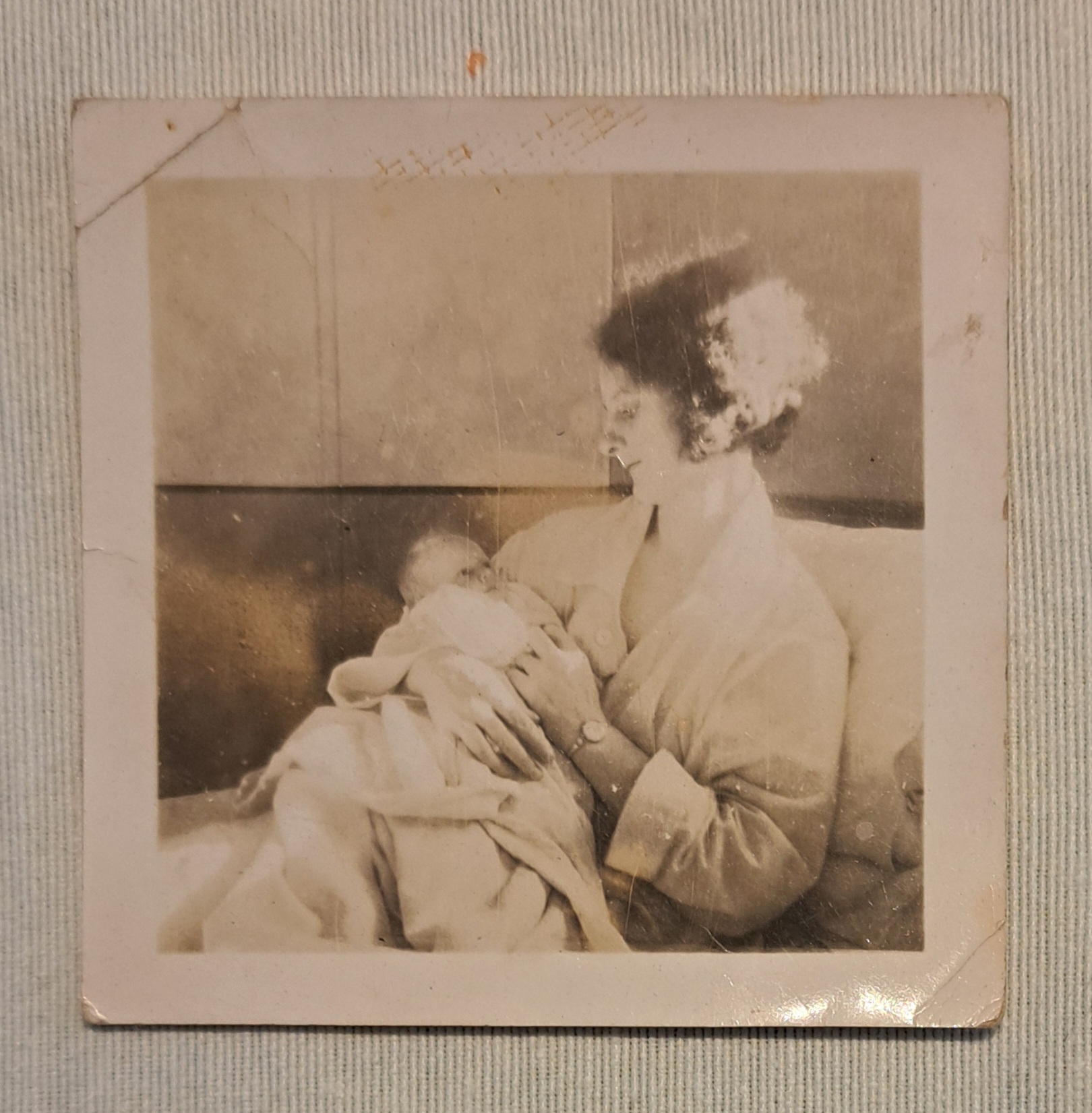
Well, my parents lived in Coventry. They were Yorkshire people, because of the 30s, no work or anything, Dad moved down to the Midlands, got a job in a factory in Coventry. War had started and the factory was doing aeroplane parts. They rented a house in Coventry. I’ve got two elder brothers. And then mum was pregnant with me. So, this is 1940.
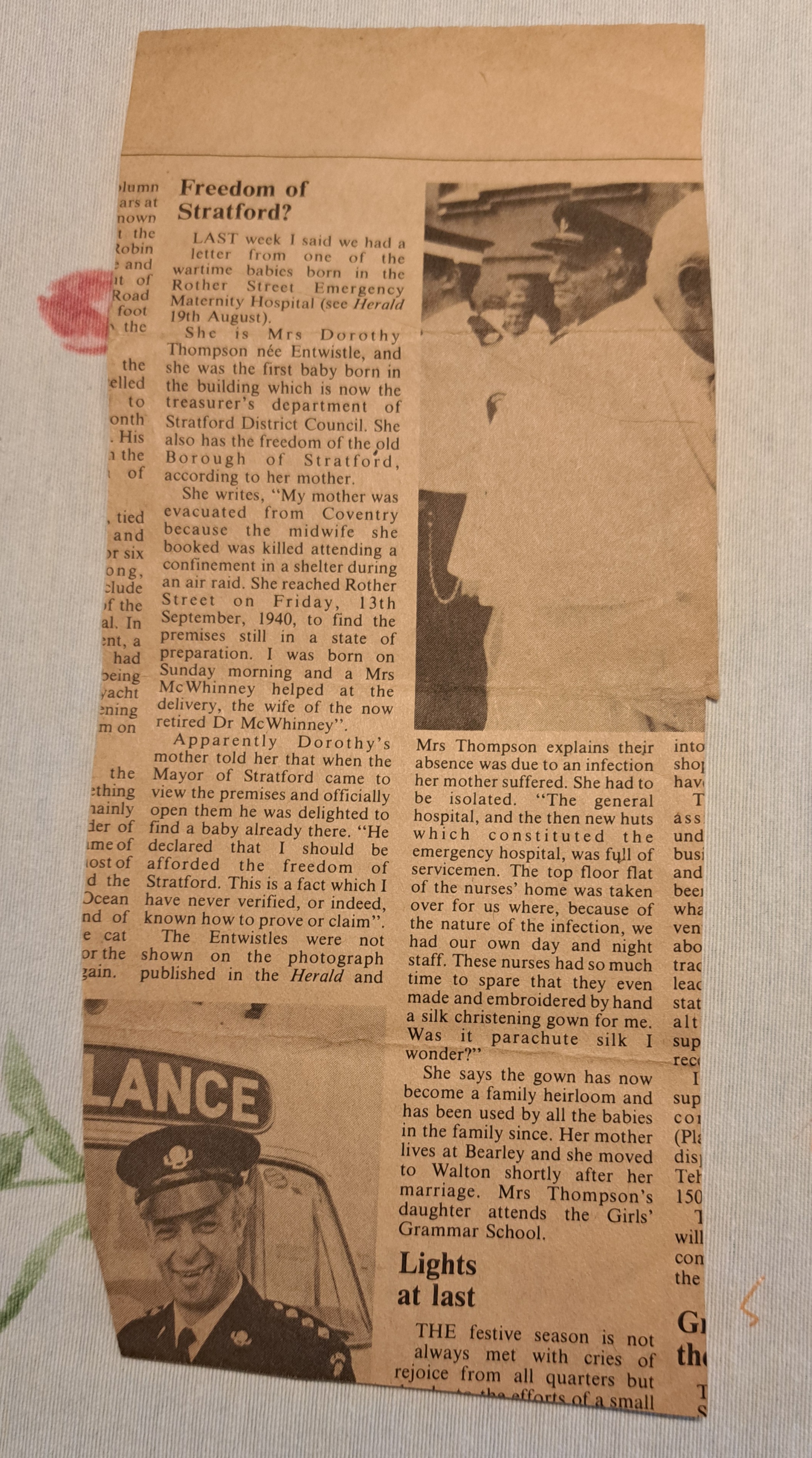
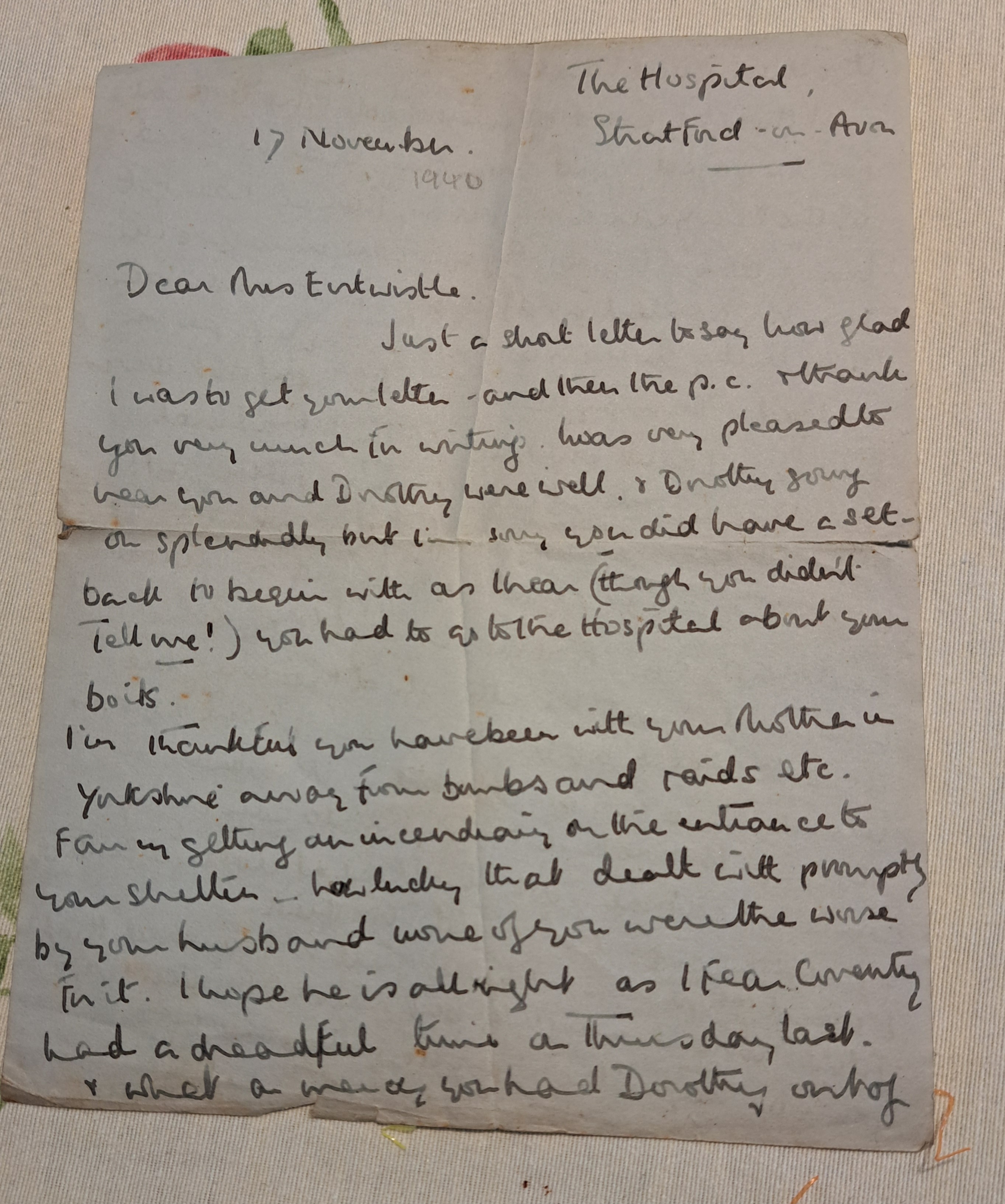
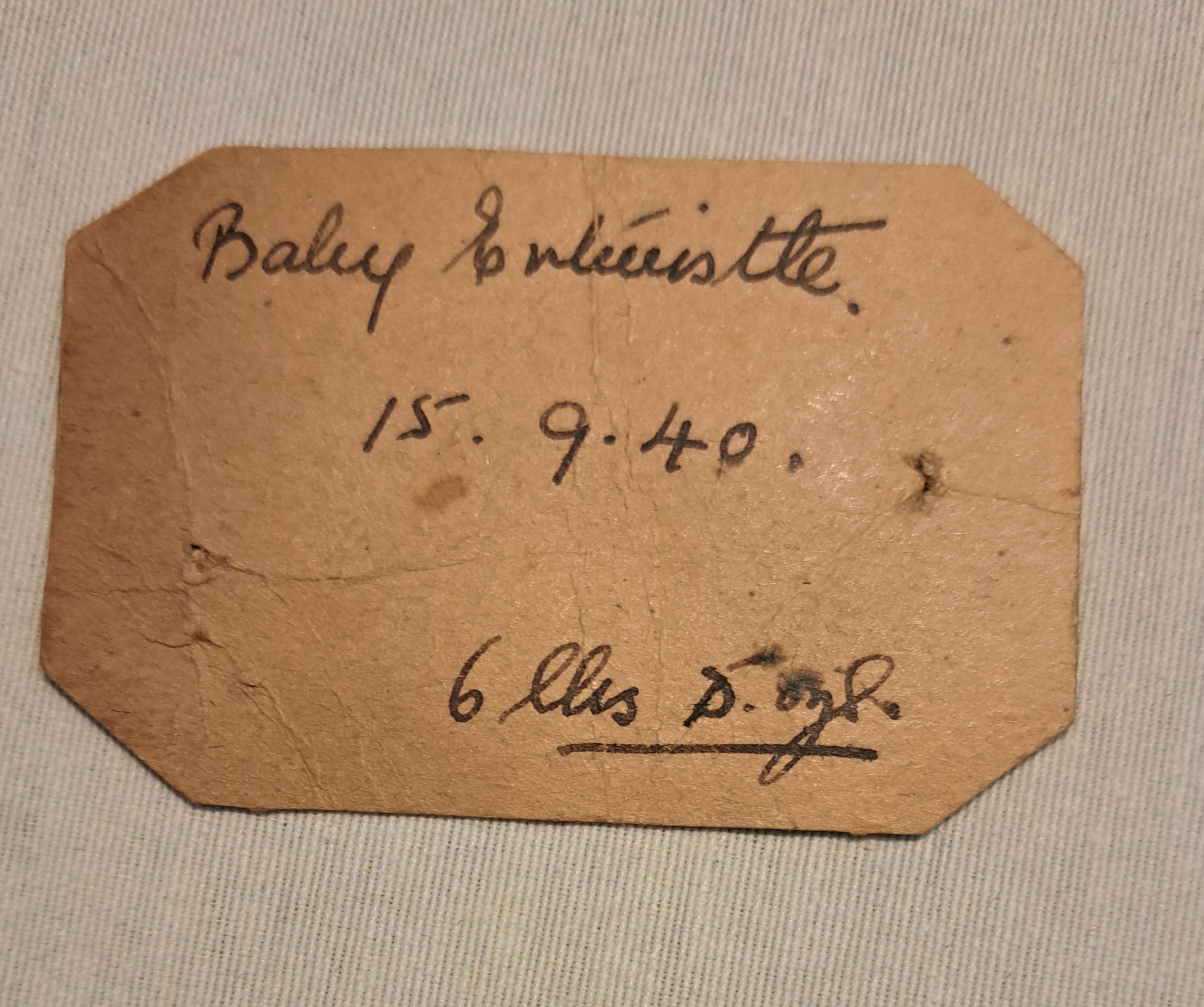
The Blitz started, of course, Coventry Blitz. I was actually born on Battle of Britain Day. You know, it’s designated 15 September as Battle of Britain Day. Anyway, Mum booked the midwife, who unfortunately was killed delivering a baby in an air raid shelter. It was a direct hit and the mother, the baby and the midwife were all killed.
That was in Coventry. So, Mum got a letter from the Council House, to meet on the steps of the council house at such time on Friday the 13th of September with a suitcase. All the mothers from the Blitz were put on a coach and taken to Stratford.
So how many were put on?
Well, I don’t know how many, but it was opened for mothers from the Coventry Blitz and the South Coast, apparently. I don’t know when they commandeered the building for the hospital. I have no idea. Mum was taken there on the 13th of September, which of course is market day. And said her window was overlooking. The market.
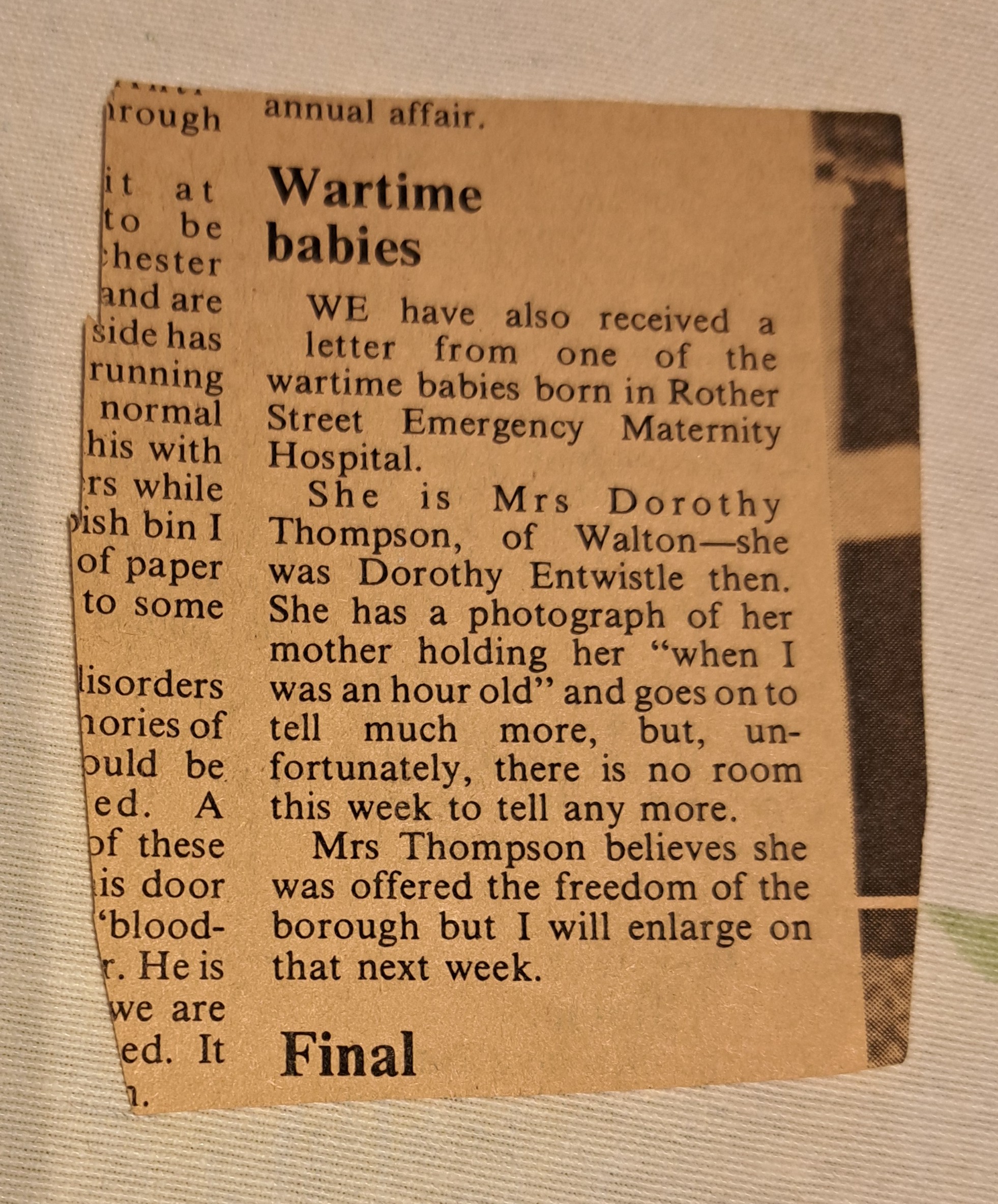
She loves markets. She thought it was so picturesque and lovely. Well, that was the Friday the 13th. And I was born at lunchtime on Sunday the 15th of September. Now, this rest is hearsay. When the Mayor came on the Monday to declare the building open, he was so pleased and surprised to find a baby already there, because I was the first one born there. According to my mum, he conferred the freedom of Stratford on me. Now, I have never been able to prove that or claim it. was just word of mouth from mum, but that’s what happened.
My friend who was going to be here today, Martin, will tell you who the Mayor was. You have a press cutting, haven’t you?
Yeah, that doesn’t cover it. I used to give talks all over the place. Well, some years ago now, I was giving a talk at the Town Hall at Stratford. And the then Mayor, whoever that was, a lady, I was telling her this story, and she said, well, we could check up. She said at the Shakespeare Centre, there’s records of all Mayoral visits and what transpired, you know. So, we made a date to go and check-up. Well, unfortunately, she couldn’t keep that appointment. And we never did go; we never remade it.
Well, my friend Martin will be able to find that out for you.
Well, I was talking to my friend Eddie last night, and he said he didn’t know whether Mayors could confer freedom of the town, whether they had the power to do that. He said, and he understood that the Shakespeare Centre was sending a lot of their records. away somewhere else to be stored.
Yes, but they’re being digitised first. So, Martin, who’s my friend, is a key researcher there. So, we’ll investigate that.
But all the time I was growing up, particularly once I’ve got my motorbike on my car, Mum used to say, you haven’t paid parking charges, have you? And I said, of course I have. There’s no way I can prove what you’re telling me.
It’s a great story though. We tried to get it for the D-Day veterans because we did a big project, and we brought all the D-Day veterans together in the town. They wouldn’t give them the freedom of the town. They gave them something else instead, they said they couldn’t give them the freedom of the town because they didn’t have sheep to parade through the streets. We’ll make you a sheep.
I used to keep goats!
We’ve got to make you a sheep for Freedom of the Town.
So that was that anyway, Mum was there, first baby born. She contracted some sort of disease or illness or whatever, and she had to be isolated. She couldn’t go to the hospital because that was when the huts were built, hospital huts and emergency huts. They were full of soldiers. A lot of them had got gangrene and that. So, she had to be isolated. So, they commandeered the top flat of the nurse’s home. Now, if you think walking up there, used to be the one little brick building as you walked up. That was the one last bit of Shakespeare Workhouse, Stratford Workhouse.
Now, hang on, which road are we on?
Arden Street. Turn up, walk straight up towards the cattle market area. And there used to be this brick-built building. That’s where they moved mum to.
Like a lodge house?
Sort of. But as I say, it was part of the old workhouse. There’s a bit of research I did doing all my family history and stuff. Eddie and I went to the Shakespeare Centre that I got.
Martin has done a lot of research. He’s really interested in connections with the workhouse.
Right. Well, because it was a nurse’s flat, we’re upstairs. Because of whatever this affliction was that mum had got, she had to be isolated. So, she had her own day nurse and day sister and her own night nurse and night sister.
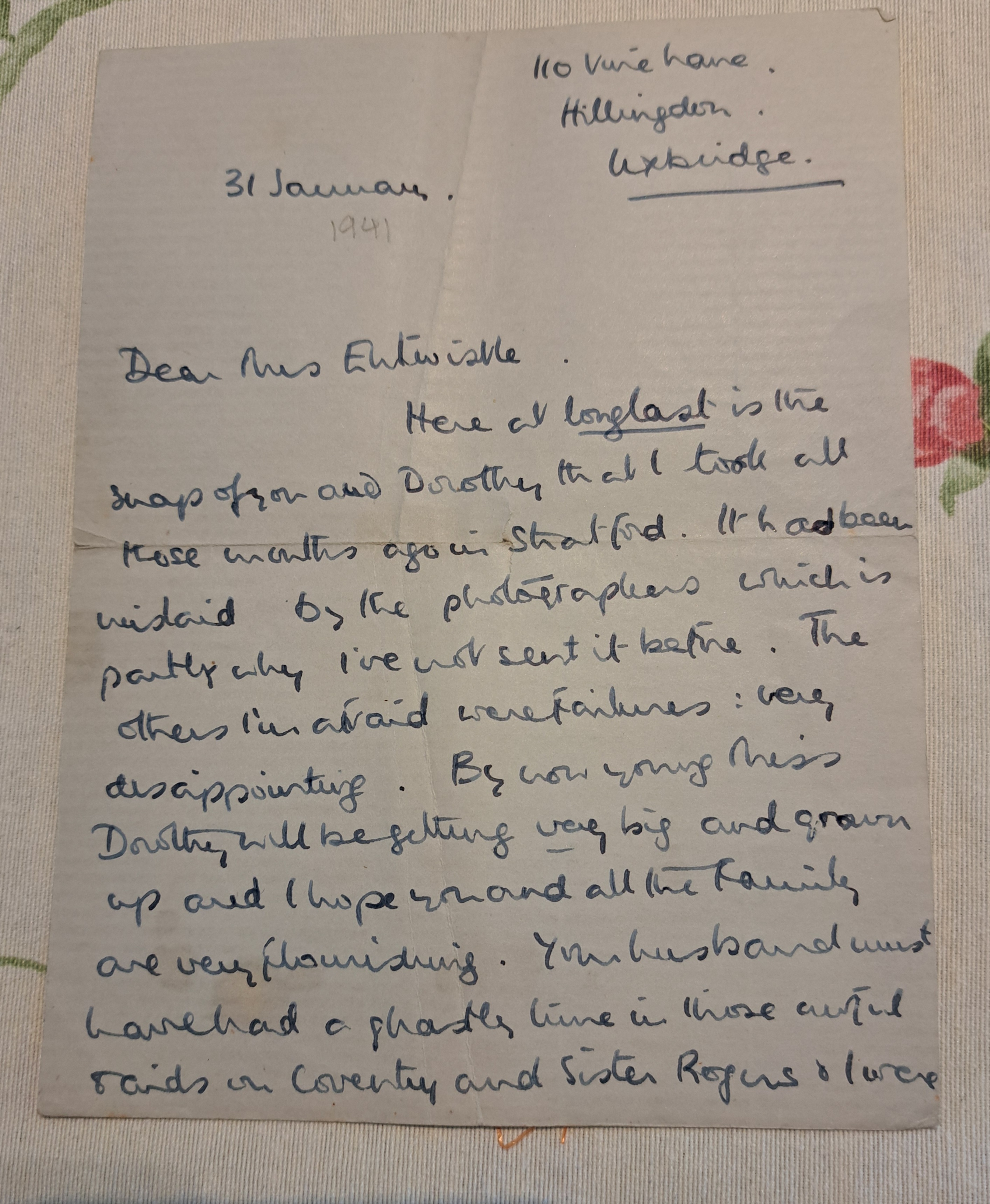
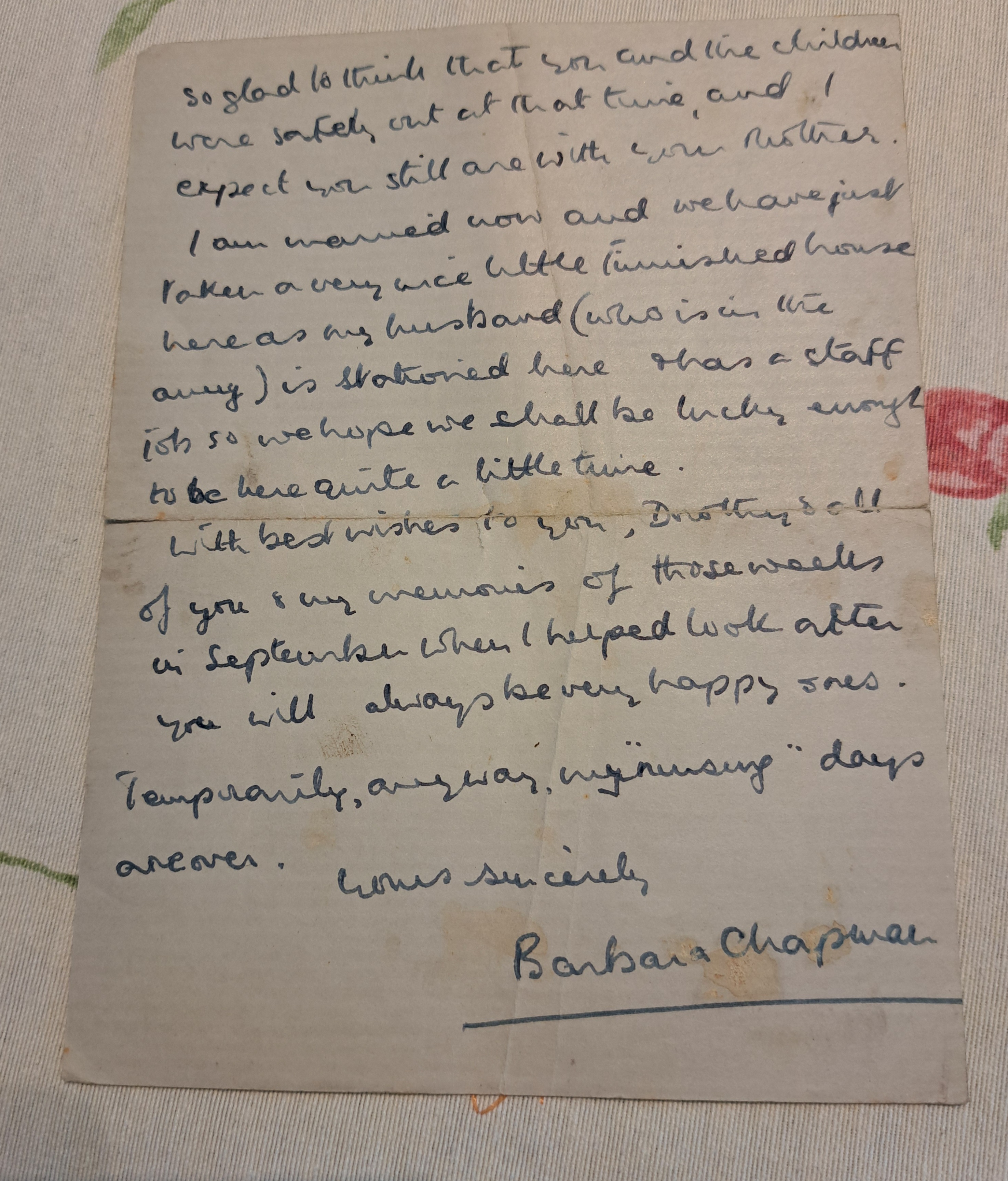
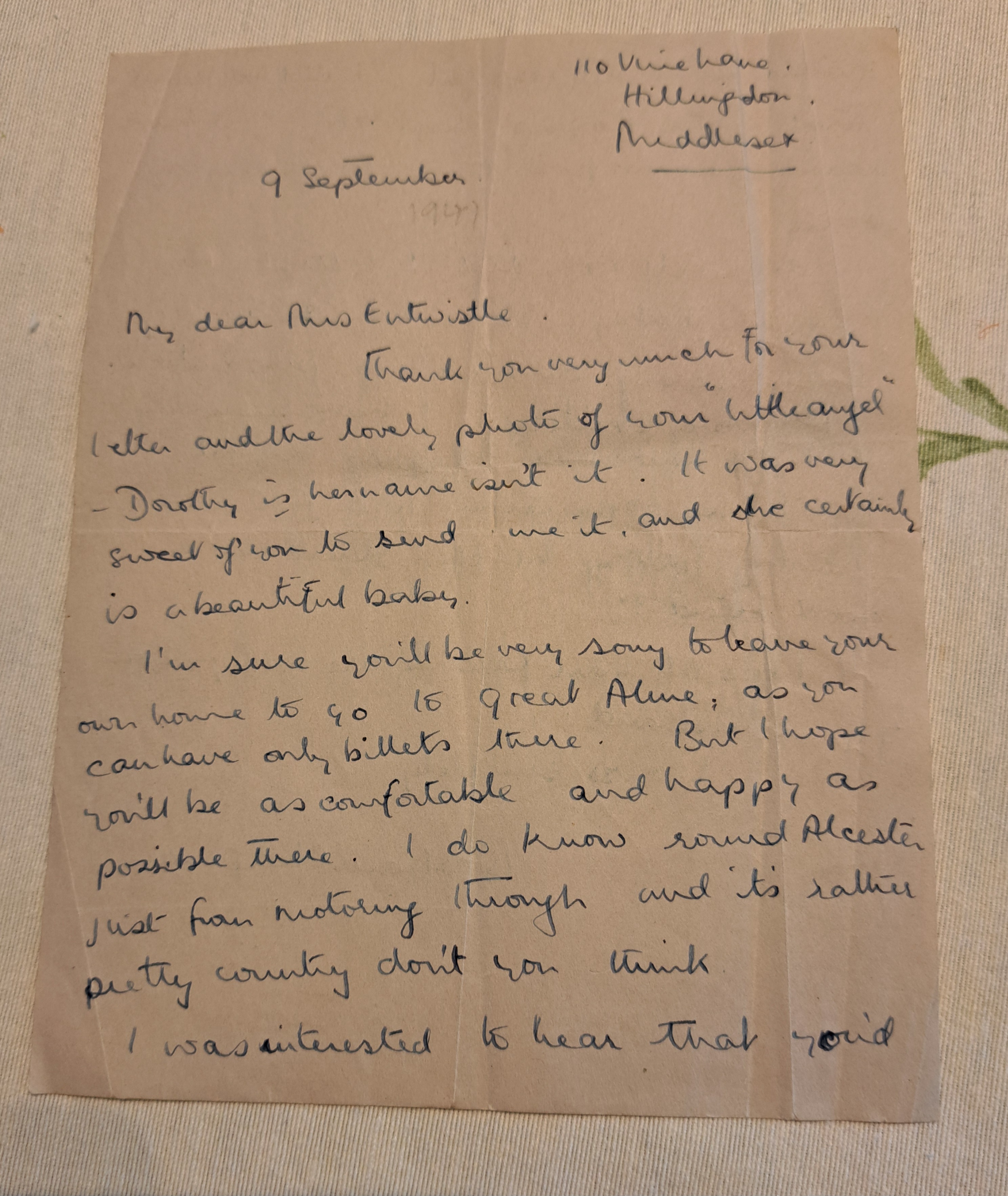
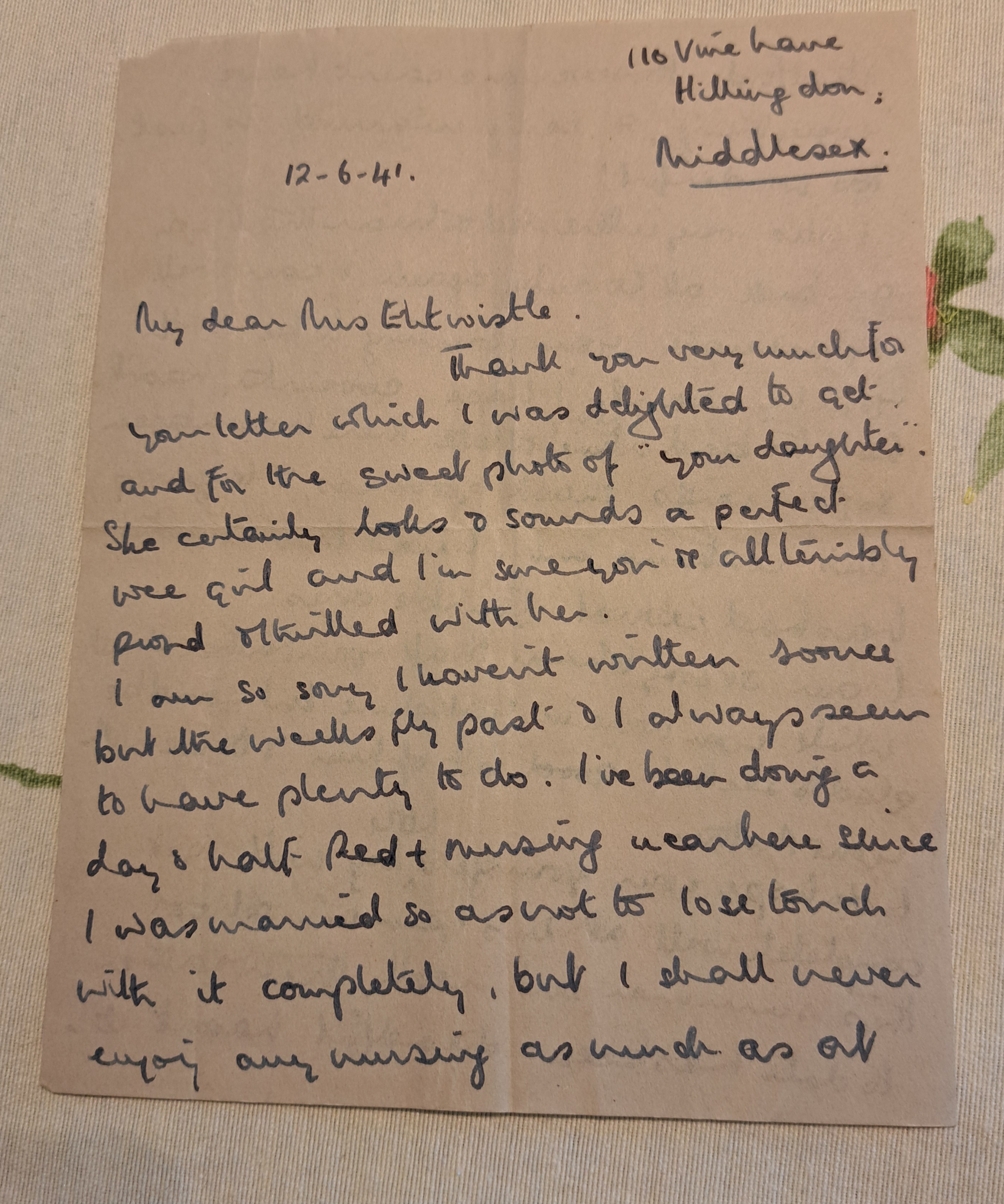
And because they’ve got so much time on their hands, they made a christening gown for me out of parachute silk and all hand embroidered and lace, handmade lace. I’ve still got it. All my family have been christened in it since. In fact, I nearly brought that to show you.
Oh, next time please do
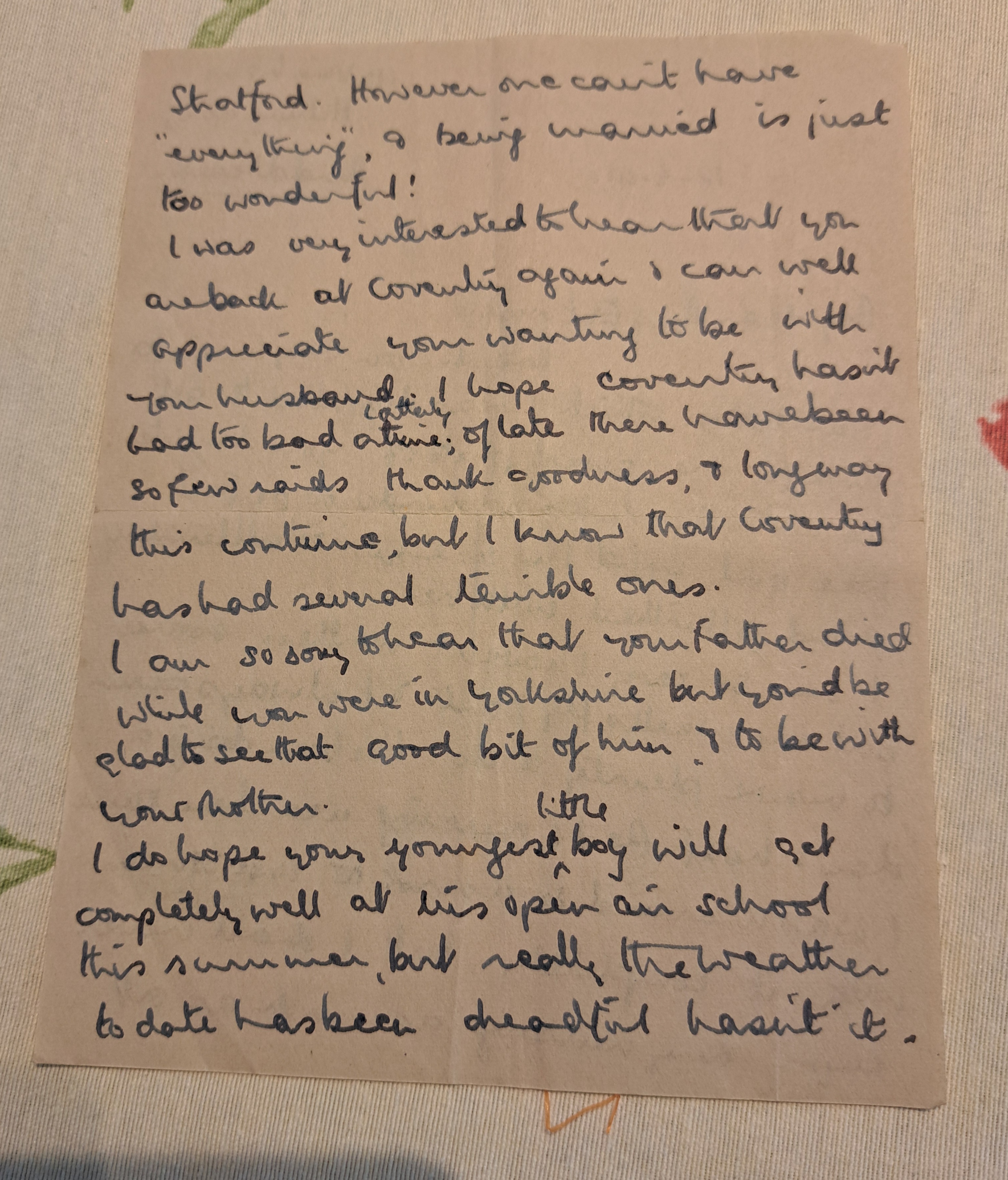
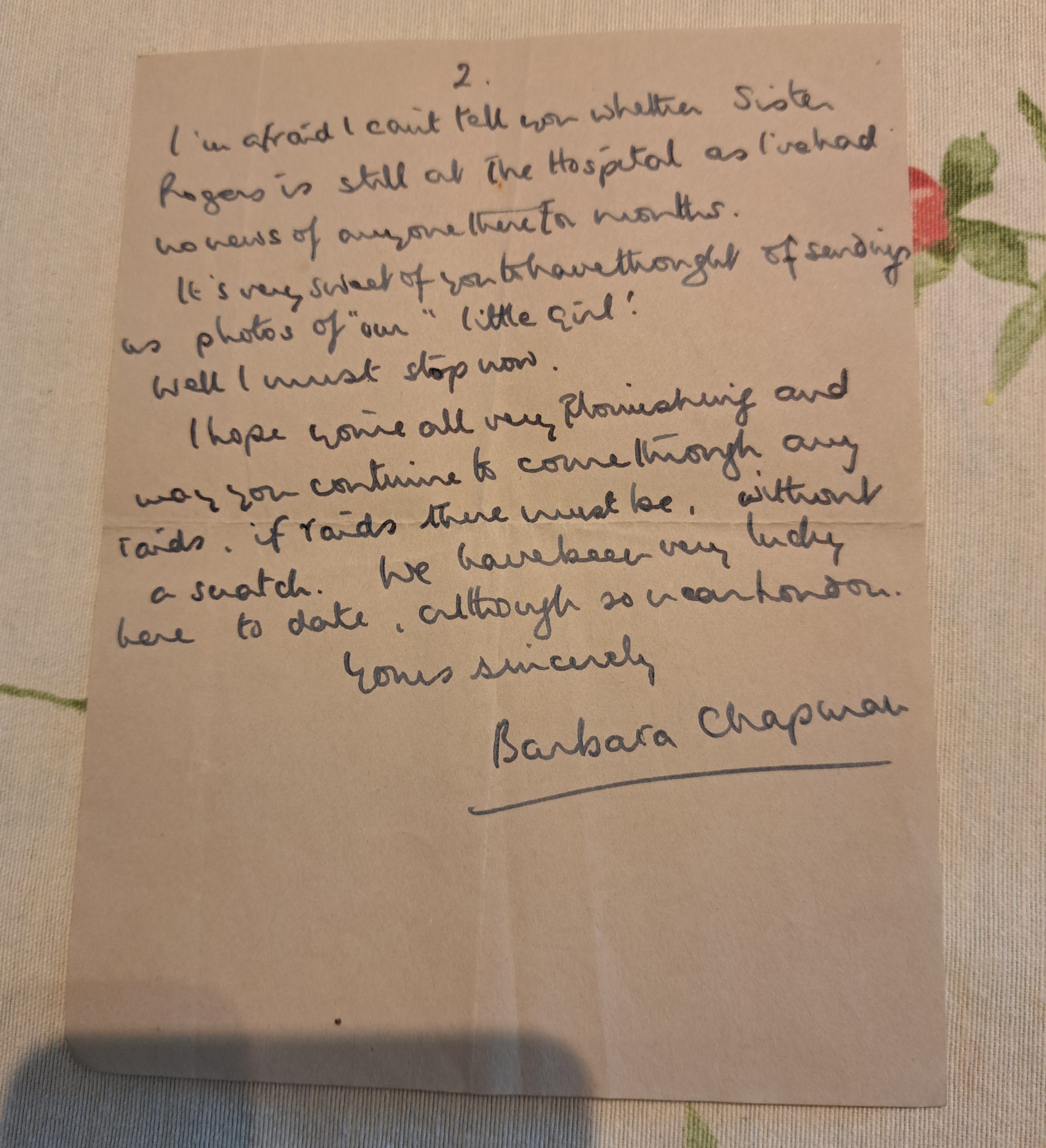
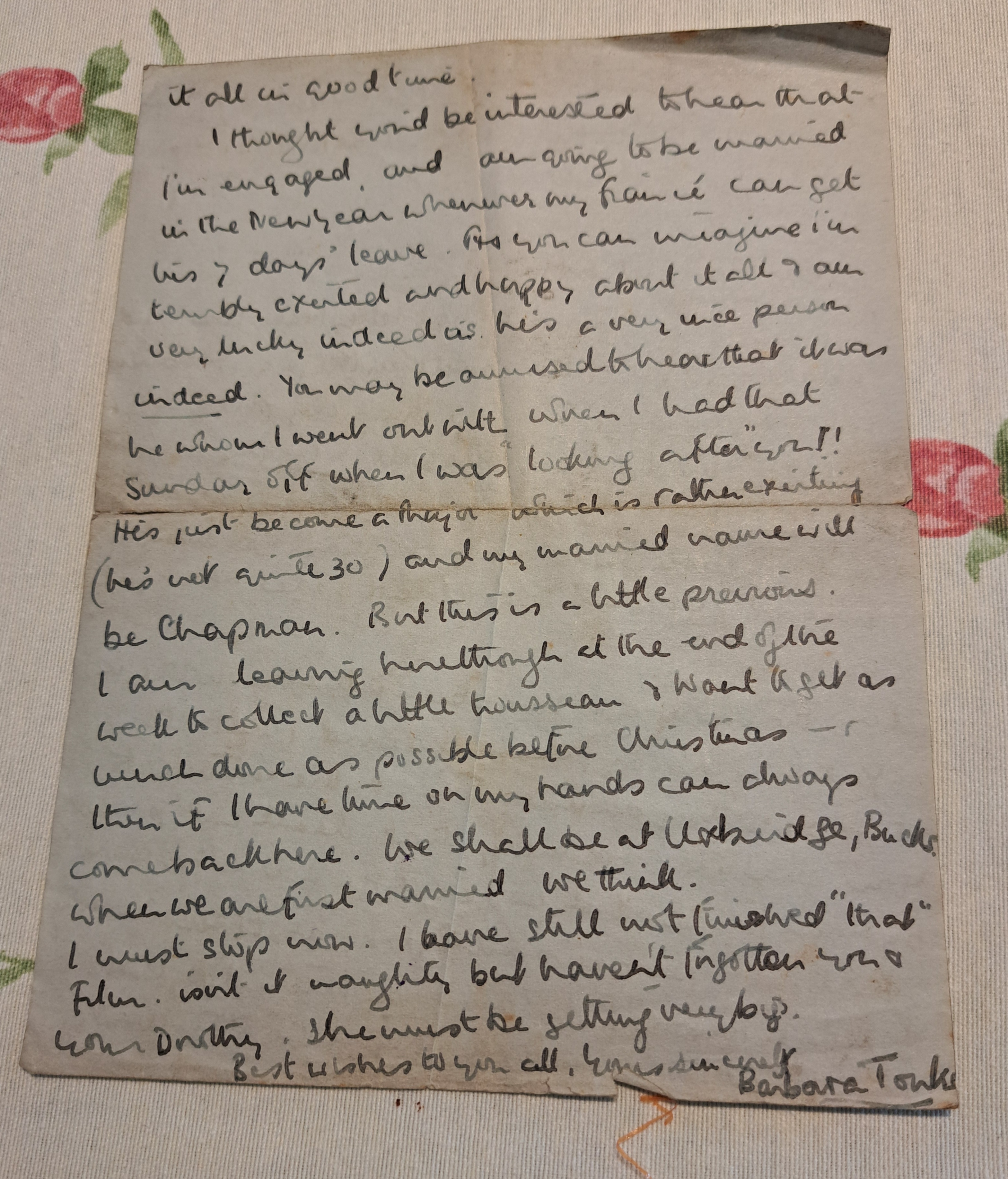
Anyway, because they made such good friends with Mum, I don’t know how long she was there., but she carried on the correspondence with one sister. After she went up to stay with her mother, who still lived in Yorkshire. My brothers had been sent up there.
So, were they evacuated up there?
Well, because of the Blitz, yeah, because Mum was away with me. You know, Dad was working. Oh, and Dad, worked at the factory. Well, because he was a key worker, he was exempt from military service.
What was your dad’s name?
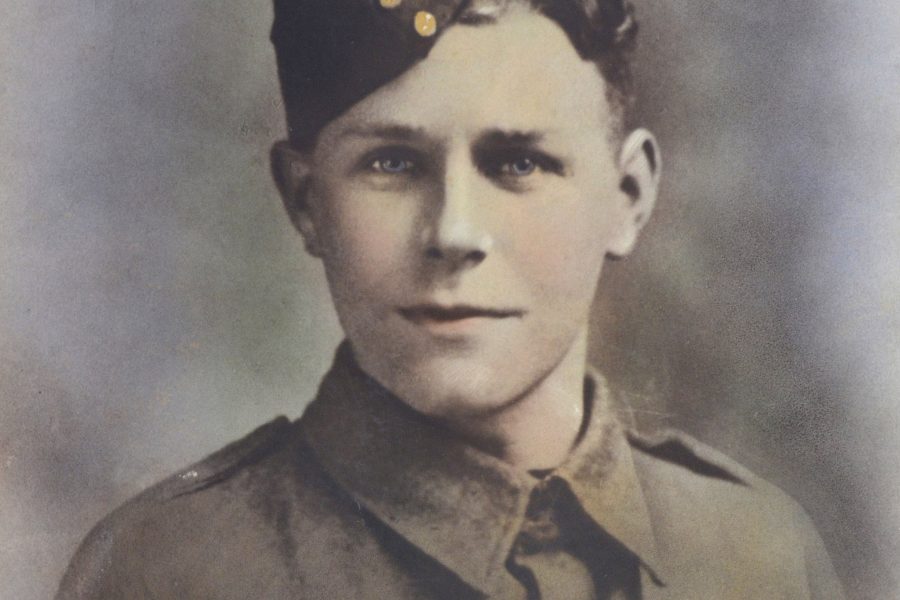
Arthur Enthistle. Because of the Blitz, they moved the factory out to Great Alne. That became the Morton Motor Company. But Dad, as one of the key workers, moved out there too. Mum and Dad and I were billeted in a cottage with an old man in Haselor.
My brothers are still at Yorkshire. Eventually, this wasn’t very good apparently, the old man used to throw all the grouts on the fire at nine o’clock and say, time all decent folk, we’re in bed, you know. They commandeered a cottage for Mum and Dad at Aston Cantlow.
We moved in there, our brothers came back home. My eldest brother’s 10 years older than me, and the next one was eight years older than me. My brother George, the next one to me, had chronic asthma and eczema all his life. He spent all his young life in and out of hospitals or, you know, isolation places, open-air places.
Did he go to the one at Birmingham Road, the isolation hospital?
No, it’s somewhere near Kenilworth, I think.
Anyway, as I said they’re that much older than me, we grew up like two separate families really. But Aston Canton was lovely. There was a farm across the road with three boys and a daughter. The daughter was the eldest. I grew up with all these boys, these three boys and my two brothers. I was convinced that I’d grow up to be a little boy eventually. Anyway, war ended. People wanted their cottage back. We had to move. Of course, we were homeless. The house at Coventry, they didn’t own it but had gone anyway. The coal man at the time, Jimmy Snell, said to Mum, people are moving into the old RAF site at Bearley, the RAF huts. So Mum went over have a look, I don’t know how she got there but we took the last hut on the site. My one brother stayed there overnight to keep it because people just come in from everywhere and the hut that we had had been the cinema for the site. We walked in there was just one great big space right to the far end with big iron cast iron stove in the middle. Because this was a cinema hut, as you went in there’s a little brick-built room. This was a projection room. So, we moved in there on the 3rd of September, 1946.
It’s a football pitch now. There are different RAF sites in Bearley. This was College Hill.
Anyway, made the newspapers. We were called the Bearley Squatters. I think I’ve got cuttings somewhere. It was in the News of the World, I think.
Dad went round and collected a nominal rent of people to show goodwill. The council did eventually take it over, Stratford District Council, because they hadn’t started the building programme of council houses then. What they did was divided each hut into two. So, there were two families in each one. But because Dad had already divided ours in such a workman-like way, I mean, it was lovely, you know, walked in, we’ve got the kitchen, little living room, went through the great big sitting room, which was full width, he built it beautifully.
So they were like pre-fabs?
Very much like that, they’re made of asbestos, would you believe. Anyway, then there was four.
Anyway, we lived there. We were rehomed when they built houses. I think we had about a third tranche of homes. And we moved in, I think, not sure whether it was ’52 or ’53, but it was sort of about the time that I started grammar school. Because I remember going on the bus, this is on the Birmingham Road. The bus used to stop outside the entrance to the camp. And when I went to grammar school, I wouldn’t get off the bus there. I stayed on it till down to Bearley Station because I didn’t want people to know that I lived on the squatters camp.
My dad was wonderful. He started a youth club.
Well, Miss Golden used to be the county youth organiser. And I remember her coming out one night for a meeting with Dad. And the lady that she lived with, Miss Phillips, was the one that ended up being my admin head at the county library.
She said she remembers coming and seeing me in my bed when I was a little thing. So, Dad started a youth club there, at the squatters camp.
The huts next to us had been the ablution block. Great big concrete sort of building with all these big concrete sinks and what have you. There’s a tower at the end where the boiler was. I don’t know if you’re recording this bit, but you know I said I always wanted to be a little boy.
All my friends there were boys.
And they used to have contests you could wee the furthest up the wall. And I was so mad that I couldn’t join in.
Anyway, once I discovered what boys were, I was very glad I was a girl. But dad, as I said, started this youth club there. They built a stage. He was always in a dance band. He’d been in a town brass band when he was in Yorkshire. But before that, he used to play for the silent movies.
All symphonies, the kettle drums on the top. Yeah. I’ve got loads of photographs of him in his band uniform. But anyway, down at College Hill, he heard that some of the Latvians up at the DP camp, that was the displaced persons camp at the top of the village, were trying to get a band together. So, he took them in hand and we used to have band practices at my house and I danced for them. And we used to have dances in this club that he’d formed.
My job was, he used to scrape candles, and I’d just sprinkle it all over the floor because it’s a concrete floor and make it more slidey for people to dance on. And because dad was in the band and mum always used to be there as well. I was, of course left at home. Me and my friend at the time, we used to do the military two step, the St. Bernard’s Waltz, the Bolita. Gay Gordon’s, all the old-time dancing. It’s lovely. I grew up dancing, really.
Oh, how fantastic. There’s a nice link back to the Artshouse, now a music/dancing venue. So, what was your mum’s name?
Amy. Amy Irene.
My eldest brother was Arthur and he sort of left home when I was 6, he was 16.
George, who’d always been in and out of rehab and hospitals, never had any formal education. No. self-taught. I mean, my dad was always considered to be the clever one, but I think mum had got a lot of innate wisdom.
Did your mum work at all before?
Not then.
But when George got to school leaving age, Mr. Hutt, who was the then the school officer or education officer or whatever he was, said that he should be registered disabled because he wouldn’t be fit to work.
George wasn’t having that.
He took himself off to Coventry. lived in a hostel, enrolled in a woodwork factory place. He started a City & Guilds course, which he gained. He became a freeman of Coventry and then worked in the factory place, a rehabilitation centre. He went full circle. He ended up being in charge of it years later and helping people who were disabled, finding an employment, like an employment officer.
He was my hero, we were very close, George and I. He’s the closest to me in age and he was always more at home than Arthur. So, Arthur left home, went to Birmingham to do an apprenticeship when he was 16.
They’ve both gone now. I’m the top of the family tree. George and I were very close, and we used to go on holidays together and do things together, you know.
Did you say that during the Blitz when mum was with you and your brothers went up to Yorkshire, that was to stay with your dad’s family?
No, to stay with my mum’s mum.
They lived at a farm. My mum was brought up on a farm. Oh, lovely. Granddad I never met was an old Dales farmer, Dalesman farmer.
I think I’ve lived a good life, you know.
I’ve just remembered. Dad ran the youth club and another fella. They built a stage. They took part of the wall down and built this big stage. Behind the stage was the billiard room. We had a full-size billiard table.
I used to have to go and let the men in when he came to play.
So, it’s like a right little community led by your dad pretty much.
Dad and this other bloke wrote the pantomimes. First one they produced was Babes in the Wood and I was the girl babe. I’ve got photos of these as well.
And then the next one was Aladdin and I was a slave girl. And then I was Alice and Alice in Wonderland.
What a great upbringing. It just shows what, in the face of adversity, what communities can do.
Dad was always very keen on books. I mean, he left school at, what was it, 12, 14, whatever. They put him in the mill to work and he didn’t like that. So, he became a sheet metal worker and then ventured into the motor industry. But dad lent a lot of his books to this youth club that he started. Unfortunately, we lost a lot of them. Books that I grew up with that I loved, you know. I’ve tried to replicate and replace them over the years. My mum was never a reader. She looked at my magazines, but she never actually read a book. When we had our first television set in 1952, still down at college hill at the squatters camp, which is then, being taken over by the council anyway. But we got a television set, one of the first in the village, and for the King’s funeral. And I remember being absolutely in awe, I couldn’t believe it, that my headmistress from the junior school was sitting there in our sitting room watching television, you know?
So how did your dad get the TV then?
The first TV I ever saw was a man in the next camp, which was Dipwell camp. They were Nissen huts. Our huts were more like prefabs. One of the men in the Nissen hut at Dipwell built his own television set. And I remember being taken to see it. It was just like the tube, no case or anything. And the first thing I saw was Muffin the Mule. Then of course it was The Queen’s Coronation. Again, the room full of people.
So how did you feel when it came to leave the camp, did you have a big party? You must have been quite sad to go?
It wasn’t vacated all at one go. It was just piecemeal. People were rehomed. People went. People used to say that everybody there wasn’t married. My mum came home one day, saw me going through the bureau, she said, what was I looking for? I said, your marriage certificate. I said, everybody said that people on college hill weren’t married. And I think to a large extent that may have been true. Because of all years, a lot of husbands left their wives and moved off and set up another home. I think that probably quite a few of the people I knew there came into that category. But yeah, I was looking for mum’s marriage certificate.
And I was born on mum and dad’s wedding anniversary, 15th of September. I told my headmistress, who was called Mrs. Banks at the time, at a little junior school, that I was born on mum and dad’s wedding day, because mum always called it her wedding day.
She went to see mother about it because she knew I’d got two brothers who were much older than me.
Mum went on to work at the Canners at Stratford.
Dad’s mum didn’t want her to go out to work. And she came over from Coventry one day on the bus, unexpected, and found mum coming home from work with a wet apron and everything and spilled the beans. So then that paid to that. But some while after that, mum got a job as the meat cook at Henley High School.
The person who’d been the cook fell and injured her back. And somebody said, well, I know Amy Enthistle, who’s a very good cook. My mum went temporary to fill in and ended up getting the job permanently.
Anyway, years later, after the war and everything, Dad got a job at Maudsley Motor Company in Coventry. No, Massey Ferguson.
Well, Maudslay said he was moved when they started the Shadow Factory at Great Alne. But when he worked for Massey Ferguson, he worked for Herman at nights.
They came home one day and said they wanted a nighttime chef. Mum applied for it and got it. I was in my late teens then, about my early 20s, just before I got married anyway. And they used to be gone every night, and I was at home on my own. But Dad had taken a caravan by then. They used to tow their caravan off and go down to Forest of Dean every weekend. Because they worked nights, they’d worked Thursday night, come home Friday morning, hitch up the caravan, go off to the forest, get their heads down for sleep for a couple of hours, they’d then get all the weekend there, then they drive back on Monday, ready to go to work on Monday evening. Nice, so they’d like a long weekend too.
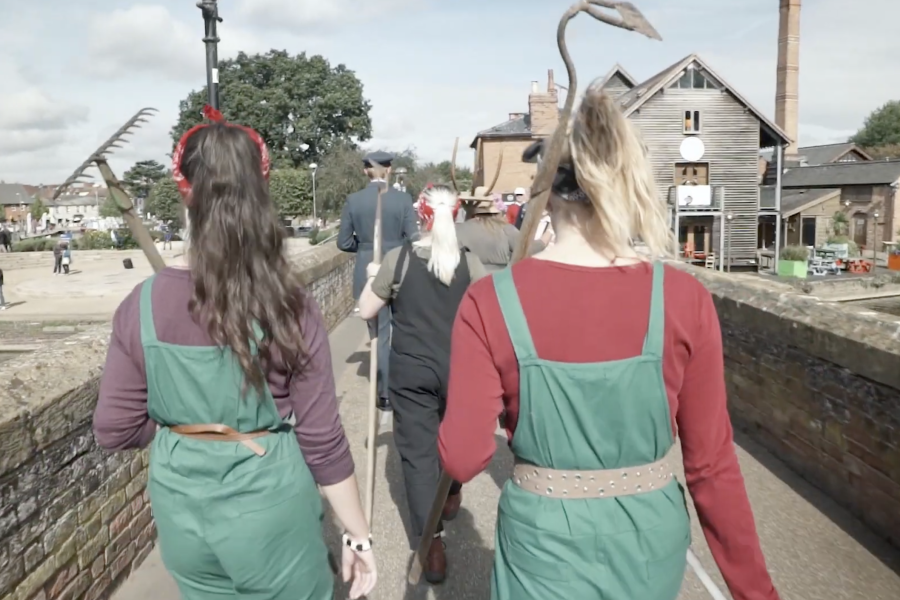
We did a lot of caravanning. When I joined the silk knot, I got my own caravan, I used to tow it all over the place, to musters all over the country.
What’s your character in the sealed art?
I was the wise woman. Of course. The witch. My living history name was Abigail Flowerdew. Because I thought Flowerdew was a very good name for a wise woman. Because it comes from the old French fleur-de-dieu, which means flower of God. So, what better name for a herbalist than? And do you remember Bob Flowerjew that used to be on Gardens World on television?
He had a long plait down his back. Well, I went to a flower show at the Royal Showground once. And I went in the flower tent and there was Bob Flowerjew. So, I went up to him for a chat and I said that I’d appropriated his name. He was quite tickled by that. I ended up giving talks all over the place. I was into reenactment for nearly 30 years. And my first talk used to be, well, the wise woman talk.
Then I had a talk about 17th century women’s dress. Wow. Then I was asked if I could talk to a gentleman’s group. Yeah. So, I talked about the civil war. And then one about the sealed not how it formed. I do talks all over the place and I used to do talks up at Bidolph where my daughter lives way before I moved up there because I got to know people up there. I gave talks at Ford Green Hall long before I ever went there as a volunteer or before I moved up there.
So, I used to make loads of costumes and then my son-in-law was a parliamentarian, I was a royalist, and I would not change, even though my regiment had almost vanished. And I used to camp on the tour show where I was supposed to, with a lot of people I didn’t know, but I used to go and socialise with my daughter when I was young and find my way back across the campsite at night, tripping over guy ropes and tents. And my son-in-law said, I don’t know why you don’t just camp with us. So, I did in the end. So, I was a royalist in the parliament camp. Yeah. They had some new recruits, and they’ve got a little boy. And of course, he’s taught to believe that the royalists were the enemies, you know. When he heard that I was a royalist one day, he thought I was an enemy in the camp. So that became a joke.
I made all the parliamentarian soldiers’ uniforms and britches and shirts. And my own CO said to me one day, I hear you are the regimental seamstress for Essex Regiment. I said, yeah. He said, why aren’t you regimental seamstress for us? I said, nobody’s ever asked me.
And I didn’t. I mean, as I say, the regiment was falling apart, very few members. I stayed with Essex Regiment camping, but I wouldn’t transfer. I wouldn’t become a parliament. I just believed so solidly in the royalist movement, you know?
And do you know Radway? What’s on the other side of Kineton?
I got approached by a lady there. They were setting up a Battle of Edge Hill Museum. There wasn’t one anywhere and they’ve got grants to set it up. Okay. And she’d heard one of my talks on 17th century ladies dress and she got in touch with Lady Hamilton for my details. And they came and asked me if I’d make the costumes for the dummies in the museum. Oh, fabulous. Which I did. So if you go to there you wi see them…
Martin was saying there was a soldier’s hospital?
In Wellesbourne that was demolished. You know where, the charity shop is in the precinct, the one next to the little electric shop. Walk straight down the precinct, go down the steps where the big new car parking is. There’s a block of flats. That hospital was knocked down to build those flats. The soldiers were brought there. Most of Wellesbourne, the precinct and where the new health centre is, that was all owned by Richard Hamilton to begin. But anyway, yeah, they knocked it down. I’ve got a picture of it.
Was there anything nearer to Edge Hill that was for soldiers?
No, not really. They mostly lived in tents, you know. They lived around. If you’re an officer, you had a tent, if you’re a pikeman or, you slept under the hedge or a haystack or barn or whatever you could find. Part of the story right away in the museum is how it affected the village because all these soldiers would move in, absolutely deplete the village of food and animals. Yeah, it was very hard for the people left behind. I wrote a poem about that.
I wish Martin was here. When you come in May, you’ll have to meet him. He’d have so much to share together because he lives and breathes history. It’d be lovely for you to meet him.
I can’t find the original cuttings. But there’s a thing about Stratford Hill, there’s a photograph of the nursing staff. And it said about Mrs. McWinney who was, I don’t know whether she’s a Matron or whatever of this new hospital, but she was the wife of Dr. McWinney who had a practice down Rother Street. And there was Father McWinney and then Ian McQuinney, the son, was in the same practice and Dr. Ferguson. And it is his wife that ran the hospital.